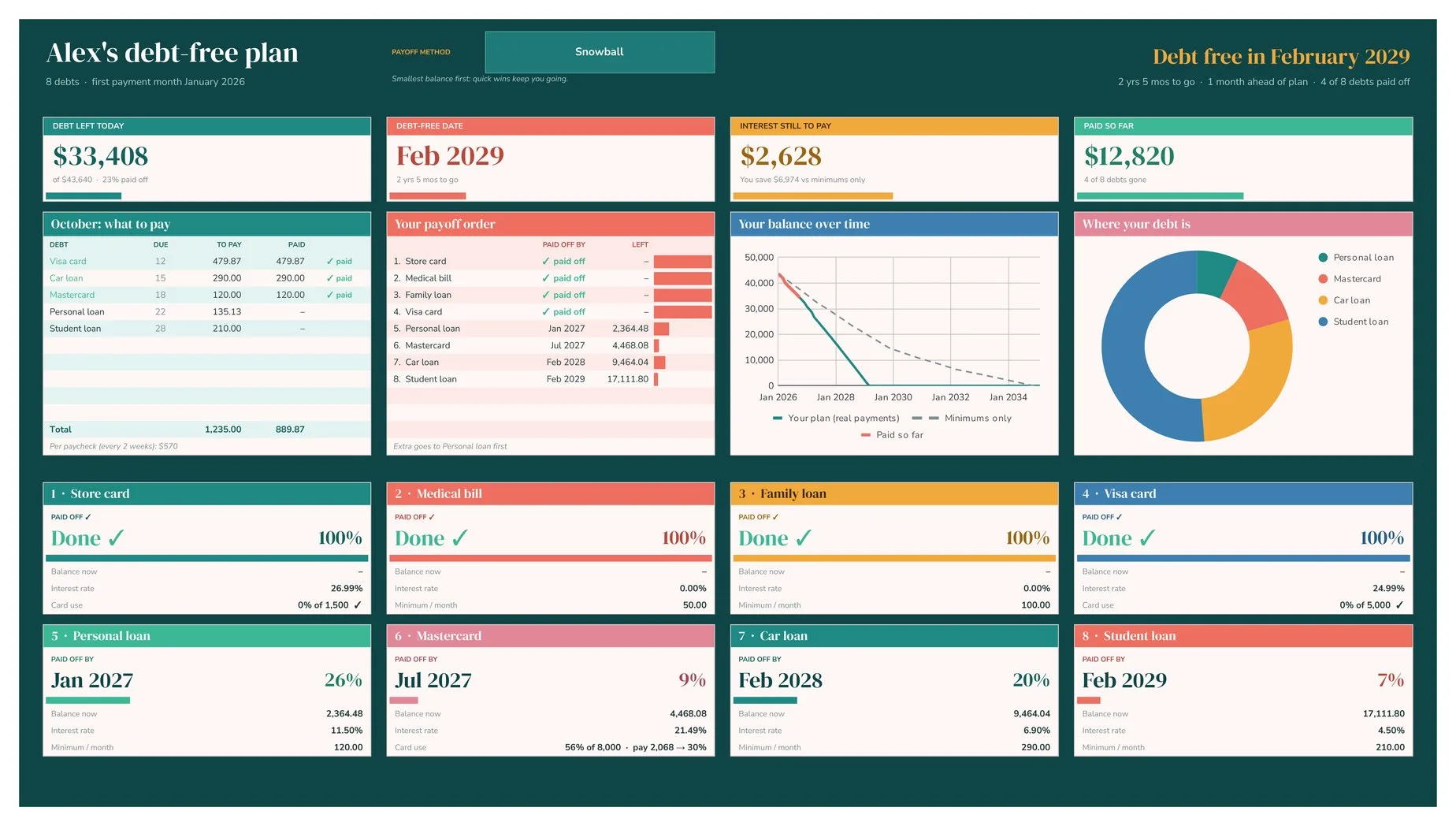
Both methods follow the same basic plan. You pay the minimum on every debt, put every extra dollar on one “focus” debt, and when that debt is gone, its payment rolls onto the next one. The only difference is which debt you focus on first.
The two methods in one sentence each
- Debt snowball: pay off the smallest balance first, whatever its interest rate.
- Debt avalanche: pay off the highest interest rate first, whatever its balance.
The snowball gives you a paid-off debt sooner, which is great for motivation. The avalanche sends less money to interest, so it’s usually a little faster and cheaper overall.
The same debts, paid both ways
Here are four everyday debts with $700 a month going toward them. Look at the payoff order: the snowball starts with the small medical bill, while the avalanche goes straight for the 26.99% store card.
The example: 4 debts, $700 a month in total ($530 of minimums + $170 extra)
| Debt | Balance | Interest (APR) | Minimum |
|---|---|---|---|
| Medical bill | $900 | 0% | $50 |
| Store card | $2,400 | 26.99% | $70 |
| Visa | $6,500 | 22.99% | $160 |
| Car loan | $8,800 | 6.9% | $250 |
Snowball smallest balance first
2 yr 9 mo
to debt-free · $4,051 interest
- Medical bill
- Store card
- Visa
- Car loan
First debt gone in 5 months (Medical bill)
Avalanche highest interest first
2 yr 9 mo
to debt-free · $3,838 interest
- Store card
- Visa
- Car loan
- Medical bill
First debt gone in 12 months (Store card)
In this example the two plans finish close together. The avalanche costs less interest, but the snowball clears the first debt sooner. That pattern is typical. The gap gets bigger when a large debt also has the highest rate, and almost disappears when your smallest debts also have the highest rates.
How the rollover works (the part that makes both work)
Say the snowball clears the medical bill. Its $50 minimum doesn’t go back into your spending. It joins the extra money on the next debt. Each paid-off debt makes the next payment bigger, which is why the plan speeds up towards the end.
This only works if your total monthly payment stays the same as debts disappear. If you pay $700 a month at the start, keep paying $700 until the last debt is gone.
Which one should you pick?
Pick the avalanche if:
- you’re motivated by numbers and like knowing you’re paying the least possible interest
- one debt has a much higher rate than the others (for example a 29% store card next to a 7% car loan)
- your debts are fairly large and will take years either way
Pick the snowball if:
- you’ve tried to pay off debt before and lost steam
- you have one or two small balances you could clear in a few months
- seeing fewer bills each month would genuinely lower your stress
Before you start: three quick checks
- Can you cover every minimum? List each debt with its balance, interest rate and minimum payment. If the minimums add up to more than you can pay, call the lender before anything else. Many offer hardship plans.
- Do you have a small buffer? Even $500 to $1,000 set aside stops one surprise bill from landing back on a credit card.
- What’s your real monthly amount? Pick a number you can pay every month, not just in a good month. You can always add one-off extras later, like a tax refund or a bonus.
See it with your own debts
Put your real debts into the free debt-free date calculator. It shows the exact month you’ll be debt-free with each method, the interest you’ll pay, and the order your debts will go. It runs in your browser and nothing is sent anywhere.
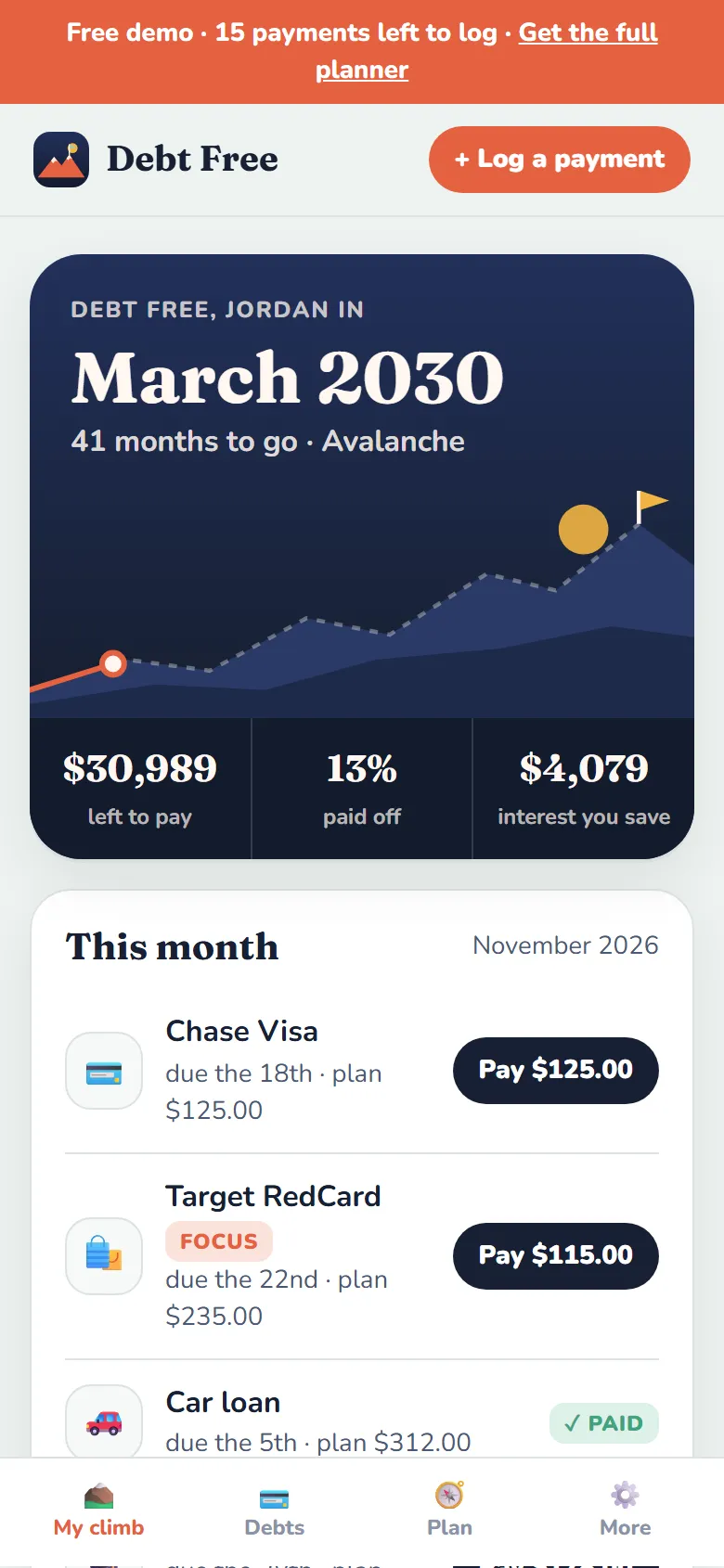
If you want to track it month by month (log payments, watch balances fall, see your new debt-free date when you pay extra), the Debt Payoff Tracker for Google Sheets and the Debt Free app do the same maths automatically.