Monthly budgets assume you get paid once a month. If you’re paid every two weeks, that doesn’t match real life. Rent might be due right before a paycheck, and one paycheck can end up covering almost every bill. The fix is to budget each paycheck on its own.
Why biweekly pay feels uneven
Biweekly means 26 paychecks a year, not 24. Most months you get two, but twice a year you get three. Your bills don’t change with them, so some paychecks feel tight and others feel roomy. Planning by paycheck smooths this out.
Step 1: List every bill with its due date
Write down every regular bill, its amount and the day of the month it’s due. Include the small ones: subscriptions, phone, insurance, minimum debt payments.
Step 2: Give each bill to a paycheck
Each bill gets paid from the last paycheck before its due date. Say this month your paychecks land on the 3rd and the 17th:
| Bill | Due | Paid from |
|---|---|---|
| Rent | 1st | Paycheck on the 17th (of the month before) |
| Car loan | 8th | Paycheck on the 3rd |
| Phone + internet | 12th | Paycheck on the 3rd |
| Credit card minimum | 20th | Paycheck on the 17th |
| Utilities | 25th | Paycheck on the 17th |
Biweekly paydays move about two days earlier each month, so a bill that’s comfortably covered now can slip onto the next paycheck a few months later. Check the match again whenever a payday moves past a due date.
If one paycheck ends up with far more bills than the other, ask the provider to move a due date. Many lenders and utility companies allow it, and it costs nothing to ask.
Step 3: Take out savings first
Decide on a fixed amount to save from every paycheck, even if it’s small, and move it on payday. Saving $50 every two weeks adds up to $1,300 a year.
Step 4: Find your safe-to-spend amount
What’s left is yours for groceries, fuel and everyday life until the next paycheck:
Paycheck − bills assigned to it − savings = safe to spend
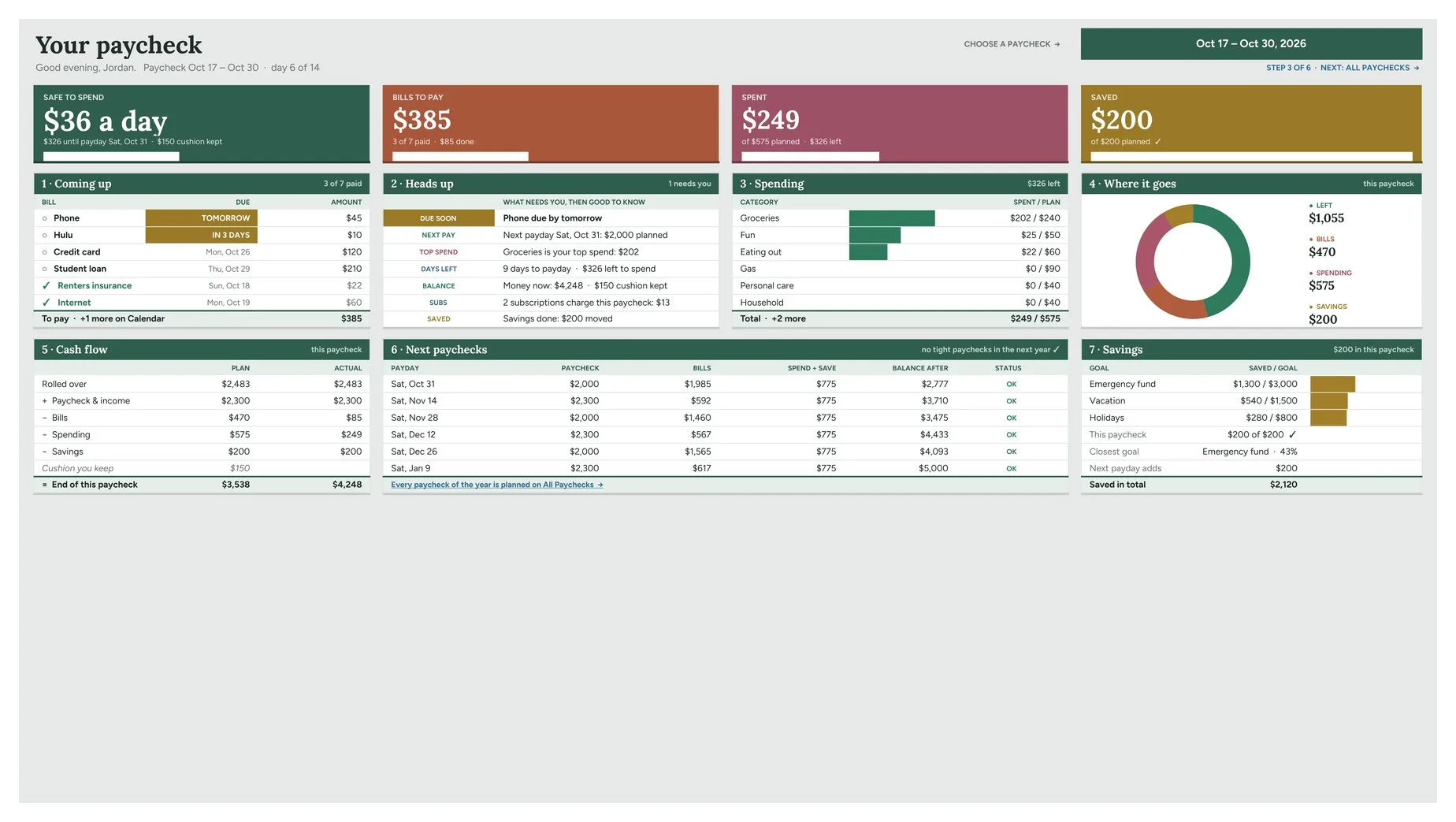
Divide it by 14 and you’ve got a daily amount. For example, $1,850 − $940 in bills − $100 savings = $810, or about $58 a day for two weeks. The safe to spend calculator does this for you in seconds.
Step 5: Plan the two extra paychecks
Because you get 26 paychecks, two months a year have a third one. Your bills are already covered by the other two, so the third is free money. Decide now where it goes, before it disappears into everyday spending:
- build or top up your emergency fund
- make an extra debt payment
- pay a yearly bill in advance, like car insurance or a membership
Make it a five-minute habit
On every payday:
- Check which bills this paycheck covers.
- Move your savings.
- Note your safe-to-spend number for the next two weeks.
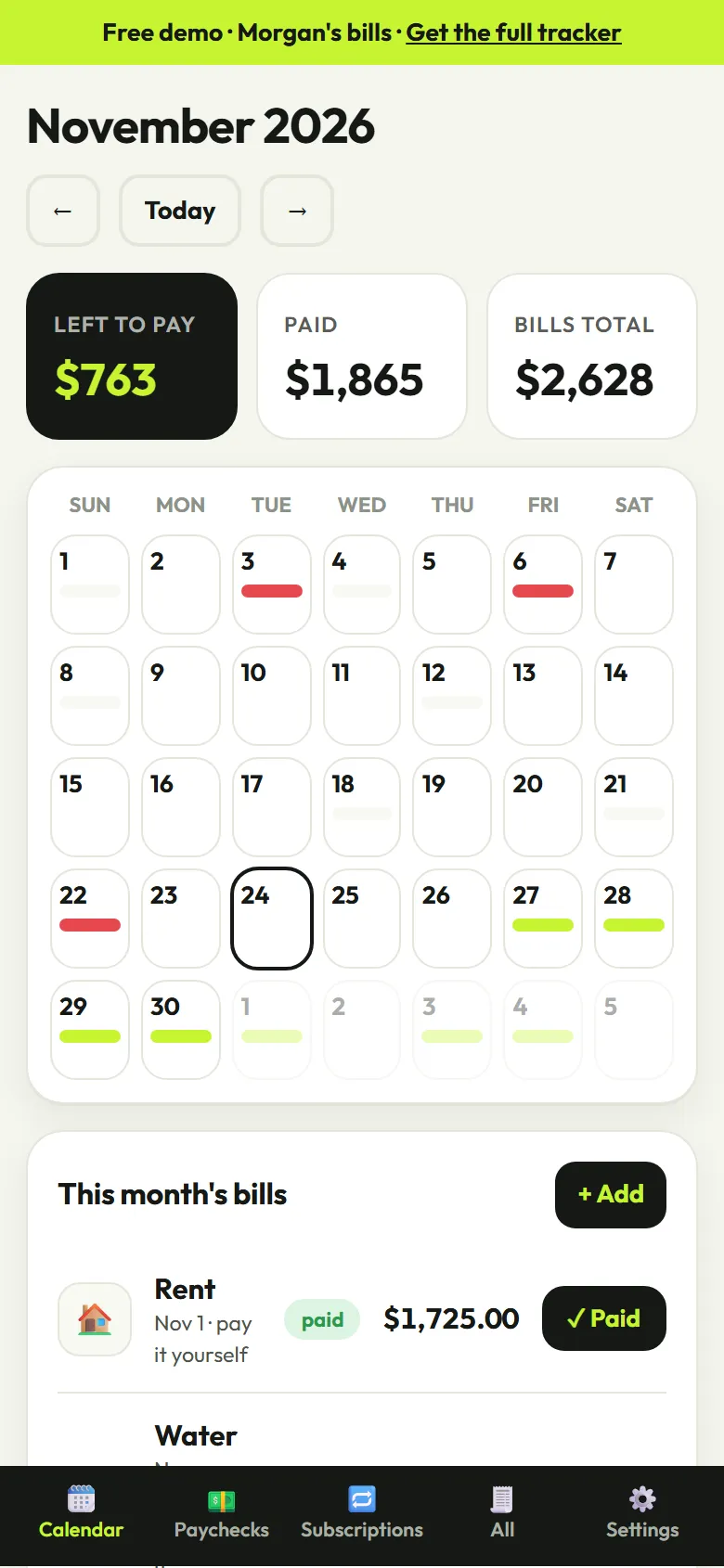
The Paycheck Budget for Google Sheets does all of this by date. You add your bills once and it shows which paycheck pays each one, plus what’s safe to spend until the next payday. If you’d rather see every bill on a calendar on your phone, Due Date does the same in an app.